


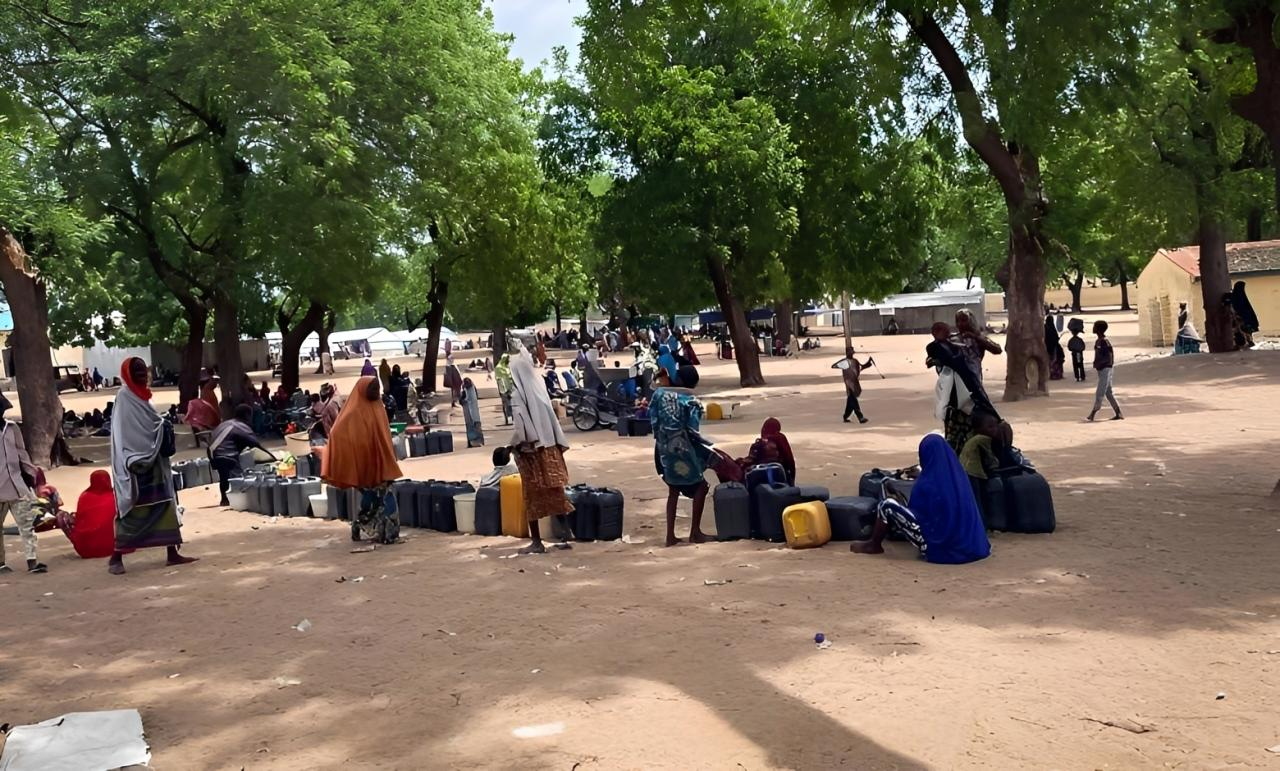
Internally displaced persons (IDPs) in Borno State say they are increasingly trapped between attacks by armed groups and reprisals from security forces, leaving many families displaced repeatedly with few safe places to seek refuge.
Modu Baluye, a displaced resident of Monguno, recalled waking to intense gunfire on the night of April 12 while staying with his family inside Government Girls’ Secondary School (GGSS), which had been converted into a temporary displacement camp.
The exchange of gunfire reportedly lasted for about four hours as Nigerian troops engaged suspected terrorists near the military’s Sector 3 base. During the pursuit, military vehicles reportedly struck buried explosives, killing the commanding officer and six other soldiers.
Residents said that after the attack, security personnel became suspicious that people living near the military base had assisted the attackers.
According to displaced residents, soldiers later searched the GGSS camp and the nearby Gana Ali settlement, arrested several suspected informants, recovered weapons, and ordered residents to vacate the communities.
Families dismantled their temporary shelters and relocated to another government settlement along the Monguno Gajiram road. Residents later reported that the abandoned settlement was burned, although it remains unclear who was responsible.
For Modu, the latest displacement is another chapter in a decade of instability. He fled his hometown of Ala in Marte Local Government Area in 2016 because of insurgent violence and had spent years rebuilding his life in Monguno before being forced to relocate again.
The incident occurred amid a renewed wave of attacks by Jama’atu Ahlis Sunna Lidda’awati wal Jihad (JAS), commonly known as Boko Haram, and the Islamic State West Africa Province (ISWAP), targeting military bases and personnel across Borno State.
Recent attacks have resulted in the deaths of several senior military officers and numerous soldiers, with assaults reported in Damboa, Damasak, Sabon Gari, Kukawa, Benisheikh, and other locations. The sustained attacks have reportedly forced security forces to consolidate troops around larger garrison towns, leaving many rural communities increasingly exposed.
Residents say they are caught between competing demands from armed groups and the military.
Armed groups reportedly force civilians to provide information, supplies, or financial levies while threatening violence against anyone suspected of cooperating with security forces. At the same time, military personnel often expect residents to provide intelligence on insurgent movements and may view communities with suspicion after attacks on security formations.
This situation has created an environment in which civilians fear retaliation from both sides. Residents say refusing to cooperate with armed groups can result in abduction or death, while any interaction with them may later be interpreted by security forces as collaboration.
Security officials have repeatedly argued that local communities possess valuable information about insurgent activities. However, community members and conflict experts say many civilians remain silent because speaking to either side can place their lives at risk.
Professor Abubakar Mu’azu, a former Director of the Centre for Peace, Development, and Diplomatic Studies at the University of Maiduguri, said longstanding mistrust between security agencies and local communities has complicated counterinsurgency efforts.
According to him, many residents are forced into contact with armed groups because they live in territories where insurgents move freely, making it difficult to avoid interaction or coercion.
Residents of Monguno also report that armed groups continue to enter some communities to purchase food, collect supplies, or carry out kidnappings despite the presence of security forces.
Many farmers, fishermen, and traders say they are often compelled to pay illegal levies to pass through routes controlled by armed groups. While these payments are made under threat, residents fear they may later be accused by security forces of financing terrorism.
Conflict analysts warn that civilians in northeastern Nigeria continue to face impossible choices as insecurity persists. Families living in conflict affected communities often risk punishment regardless of whether they cooperate with armed groups, assist security forces, or attempt to remain neutral.
The continuing cycle of violence, displacement, suspicion, and repeated attacks has left thousands of internally displaced persons in Borno facing ongoing uncertainty, with many struggling to rebuild their lives while caught between armed groups and military operations.








Leave a comment