


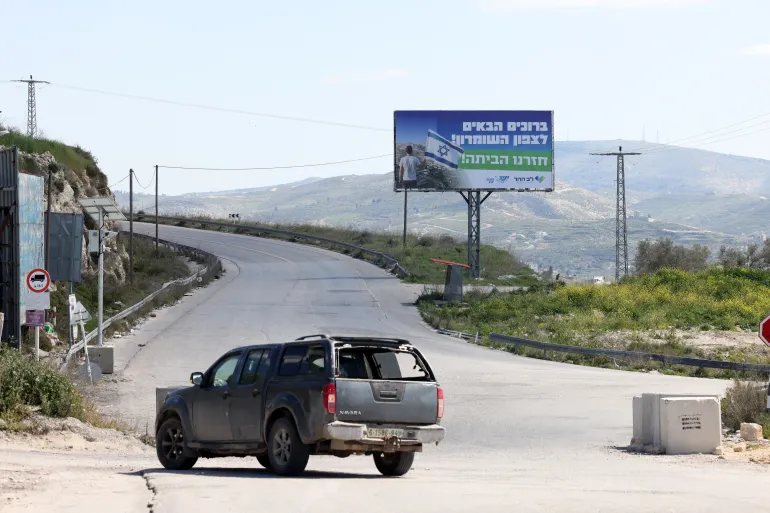
Source: Al Jazeera
Israel’s Security Cabinet has approved plans to establish 13 new settlements in the occupied West Bank, a move that Palestinian officials say will further entrench Israeli control over the territory and undermine the prospects of a future Palestinian state.
According to Israeli media reports cited by Al Jazeera, the new settlements will be developed in the Binyamin regional area, one of the largest Israeli settlement blocs in the central West Bank. The decision marks another significant expansion of settlement activity in territory that the international community considers occupied under international law.
New Settlements Planned Along Strategic Corridor
The proposed settlements will be built along Route 60, the West Bank’s main north-south highway, which links major Palestinian cities such as Nablus, Ramallah and Bethlehem while also serving several Israeli settlements.
Palestinian authorities say the first phase of the project is expected to begin in the coming months and will involve the construction of between four and six new settlements, supported by investments worth millions of Israeli shekels.
The plan also includes the legalization of several existing pastoral outposts, allowing them to receive government funding, infrastructure, and public services.
Palestinians Warn of Greater Territorial Fragmentation
The Jerusalem Governorate condemned the move, warning that the expansion would create new realities on the ground by linking existing settlement blocs and tightening Israeli control over key areas of the occupied West Bank.
Officials said the project focuses on two strategic corridors: one stretching northwest of Jerusalem and west of Ramallah along Route 60, and another extending east toward the Jordan Valley.
According to Palestinian officials, the expansion would further isolate occupied East Jerusalem from surrounding Palestinian communities, restrict movement between Palestinian towns, and weaken the territorial continuity needed for a viable and geographically connected Palestinian state.
In a statement, the Jerusalem Governorate described the decision as a “dangerous escalation” and said it represented another violation of international law. It called on the international community to take urgent action to halt continued settlement expansion.
Settlement Expansion Accelerates
The approval comes amid a sharp increase in Israeli settlement activity across the occupied West Bank.
Figures released by the Palestinian Forum for Israeli Studies (MADAR) indicate that settlement outposts have expanded rapidly in recent years. While an average of eight new outposts were established annually between 2012 and 2022, that number rose to 32 in 2023, increased to 62 in 2024, and reached 86 during 2025.
The report also says Israeli government funding for settlement outposts has grown substantially, with allocations rising from 28 million shekels (approximately $7.5 million) in 2023 to 75 million shekels (around $20 million) in 2024. Authorities are reportedly planning financial support for as many as 70 settlement outposts.
Concerns Over Future Expansion
The Binyamin settlement plan follows reports that Israeli settlement groups are considering expansion into Area A, parts of the West Bank that remain under full Palestinian civil and security control under the Oslo Accords.
Palestinian leaders argue that such moves would represent another major challenge to existing agreements and further reduce the prospects for a negotiated peace settlement.
More than 700,000 Israeli settlers currently live in settlements across the occupied West Bank and East Jerusalem, territories captured by Israel during the 1967 Middle East war.
International Response
Most countries and the United Nations regard Israeli settlements in the occupied Palestinian territories as illegal under international law, arguing that they violate the Fourth Geneva Convention, which prohibits an occupying power from transferring parts of its civilian population into occupied territory.
Israel disputes that interpretation, maintaining that the status of the territories should be resolved through direct negotiations.
The latest settlement announcement is expected to draw renewed international scrutiny as concerns grow over the future of the two state solution and the continuing deterioration of conditions in the occupied Palestinian territories.








Leave a comment