


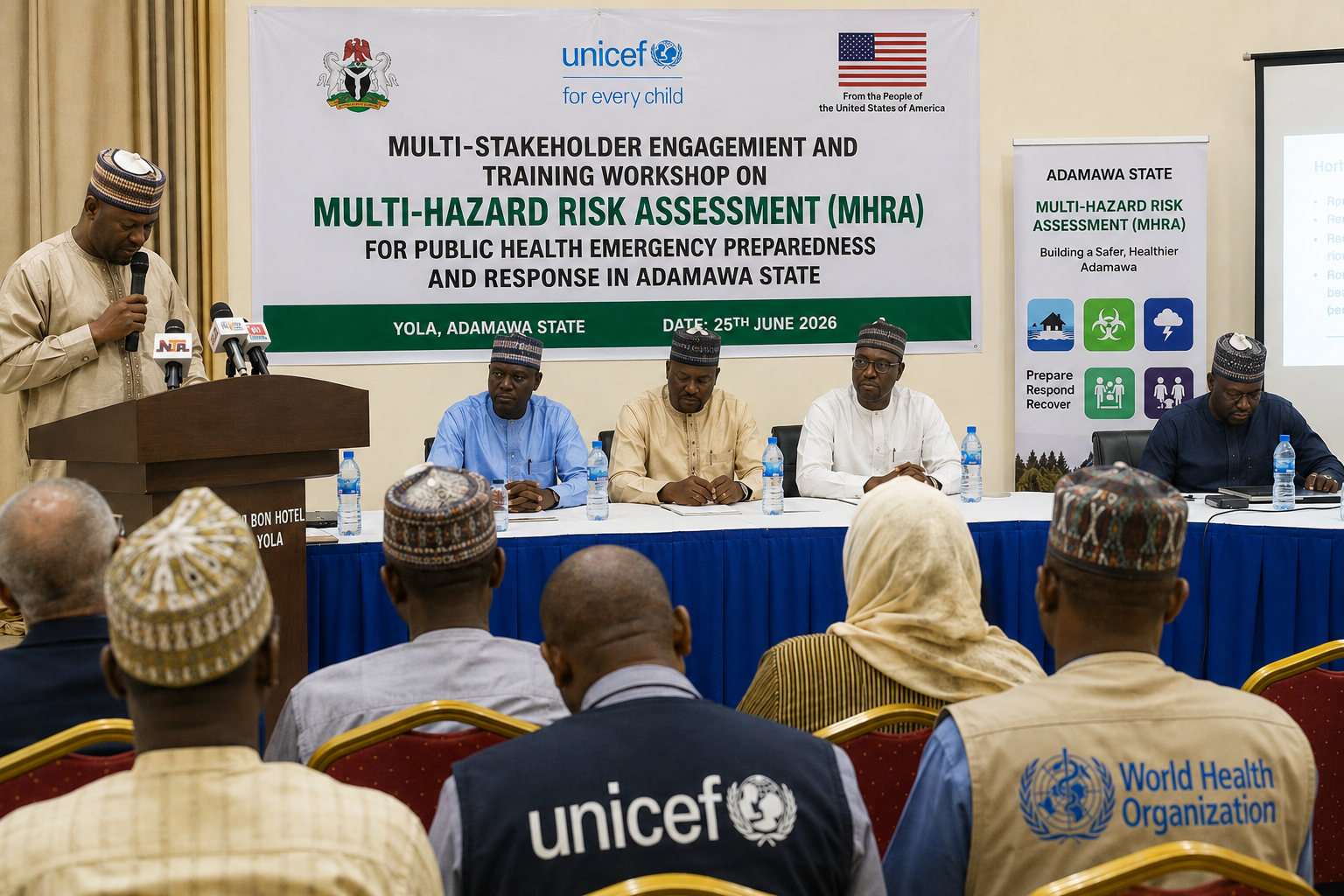
The Federal Government, in collaboration with the Adamawa State Government, UNICEF, and with support from the United States Government, has launched a multi stakeholder initiative to strengthen public health emergency preparedness and response to flood-related and other health hazards in Adamawa State.
The initiative, which features a five day training workshop on Multi Hazard Risk Assessment (MHRA), commenced in Yola, the state capital, amid growing concerns over the state’s vulnerability to flooding and disease outbreaks during the rainy season.
Declaring the workshop open, the Adamawa State Commissioner for Health and Human Services, Muhammad Chubado Jada, described the exercise as a significant step towards developing a comprehensive framework for public health emergency preparedness and response in the state.
Represented by the Permanent Secretary of the ministry, Pharmacist Zira Mathias Babani, the commissioner urged participants to actively engage in the training and contribute to the development of policies and strategies that would safeguard the lives and well being of residents.
He noted that Adamawa remains highly vulnerable to flooding, which often leads to outbreaks of waterborne diseases and other public health challenges.
“Adamawa State is at a high risk of flooding, which is a major cause of many illnesses, particularly waterborne diseases. This training is therefore timely,” he said.
Speaking with journalists on the sidelines of the workshop, UNICEF Health Specialist, Dr. Eghe Abe, said participants were drawn from relevant government ministries, departments and agencies, security institutions, development partners, and non governmental organizations to collectively identify solutions to public health threats confronting the state.
According to him, the training is aimed at identifying and prioritising multi-hazard public health risks and developing effective strategies for managing them through proper planning and preparedness.
“Public health emergencies are becoming increasingly frequent due to disease outbreaks, climate change, and other emerging threats. UNICEF is supporting the Adamawa State Government in developing a multi hazard risk assessment framework that will help identify and address recurring threats,” Abe said.
He explained that the intervention is being implemented in partnership with the Federal and Adamawa State Governments and funded by the United States Government through UNICEF.
Abe said the hazards being assessed include biological, chemical, environmental and security related threats such as cholera, measles, Ebola, COVID-19, flooding, erosion, communal conflicts, banditry and terrorism.
Also speaking, the Adamawa State Epidemiologist, Kadabiyu Jones, described the initiative as timely, noting that it would significantly strengthen the state’s capacity to prevent, prepare for and respond to public health emergencies.
He said the multi hazard risk assessment document being developed would serve as a strategic guide for the rapid identification, assessment, preparedness and response to emergencies across the state once finalised .





Leave a comment