


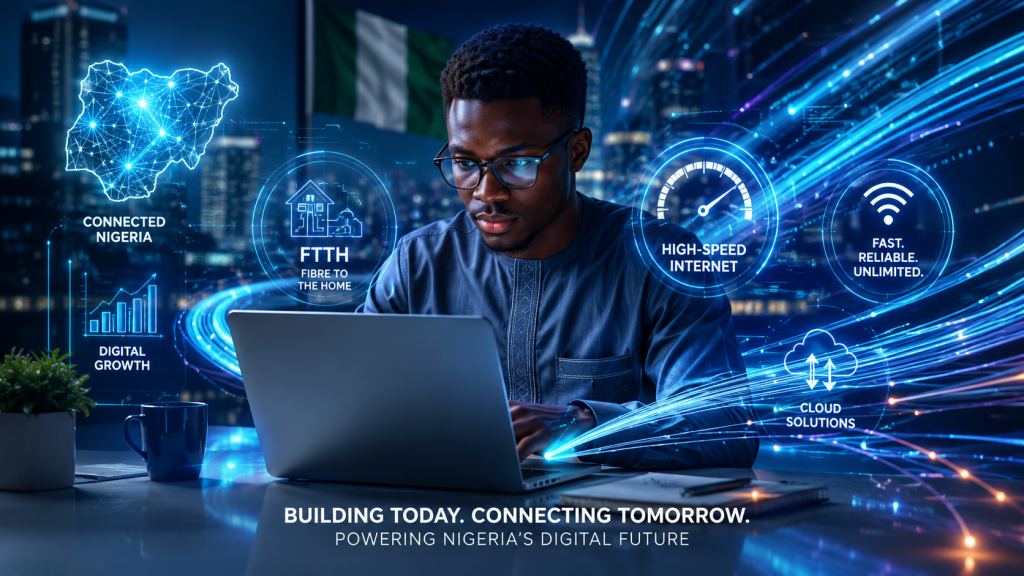
Nigeria is embarking on an ambitious journey to transform its digital landscape through a massive expansion of Fibre-to-the-Home (FTTH) infrastructure. From a relatively small number of fibre connections today, the country aims to increase coverage by nearly 160 times and connect millions of households by 2028.
However, this push is about far more than faster internet speeds. It represents a critical step toward building the infrastructure needed to support Nigeria’s rapidly growing digital economy.
The Broadband Gap
Despite having over 154 million active internet subscriptions and broadband penetration exceeding 55 per cent, fixed broadband adoption remains extremely low. According to the Nigerian Communications Commission (NCC), only about 265,000 active FTTH subscriptions currently exist nationwide.
This places Nigeria significantly below both the African average and the global benchmark for fixed broadband penetration. Industry stakeholders argue that this gap leaves millions of homes, businesses, schools, and healthcare institutions without access to reliable, high-speed internet.
During the Association of Telecommunications Operators of Nigeria (ATCON) Critical Conversation Forum on FTTH in Lagos, industry leaders stressed that expanding fibre infrastructure is essential if Nigeria hopes to unlock the full potential of its digital economy.
Infrastructure Challenges Threaten Progress
Building fibre networks in Nigeria remains a difficult and expensive undertaking.
Between January and December 2025, the telecommunications industry recorded more than 27,000 fibre cuts, thousands of access denials, and over 4,000 cases of infrastructure theft and vandalism. These incidents frequently disrupt services for businesses, educational institutions, and households that depend on internet connectivity.
Industry experts also highlighted the poor state of fibre management in several urban areas, where cables are often improperly installed or dangerously overloaded on utility poles.
To address these issues, ATCON has launched a Fibre Clean-Up Project, beginning with pilot phases across major Lagos districts, including Ikeja, Lekki Phase 1, and Victoria Island.
The Right-of-Way Problem Persists
Another major obstacle to fibre deployment is the long-standing issue of Right-of-Way (RoW) charges.
Although 13 Nigerian states have completely waived these fees and 16 others have adopted the National Economic Council’s recommended rate of ₦145 per linear metre, operators say costs remain high due to additional levies imposed by local communities and landowners.
Telecommunications companies argue that beyond reducing fees, governments must also introduce stronger legal protections for critical communications infrastructure.
Fibre as an Economic Driver
Industry leaders believe that expanding fibre networks could deliver significant economic benefits.
Studies presented at the forum suggest that every 10 per cent increase in fixed broadband penetration can contribute approximately 1.5 per cent growth in a country’s Gross Domestic Product (GDP).
Experts therefore urged governments and urban planners to integrate broadband infrastructure into the early stages of city and estate development, treating internet connectivity with the same importance as roads, electricity, and water supply.
Infrastructure Sharing Could Be the Solution
A key theme throughout the forum was the need for greater collaboration among operators.
Building separate fibre networks for every provider is increasingly viewed as financially unsustainable. Instead, industry stakeholders are advocating infrastructure-sharing models that allow multiple service providers to use the same fibre networks.
Several companies showcased shared-network initiatives already underway in Lagos, with plans to extend fibre coverage to more than one million homes in the coming years.
Experts believe that shared infrastructure can reduce costs, eliminate unnecessary duplication, and accelerate broadband access across underserved communities.
The Funding Challenge
Deploying fibre infrastructure also requires substantial long-term investment.
Industry executives warned that fibre projects often take years to become commercially profitable due to high deployment costs, vandalism risks, and slow customer adoption.
They called for patient, infrastructure-focused investment that prioritises long-term national development over short-term financial returns.
Without sustainable funding models, experts fear that Nigeria could move from a problem of internet availability to one of affordability, where high-quality broadband exists but remains inaccessible to many citizens.
The Road Ahead
At the conclusion of the forum, participants agreed that achieving nationwide FTTH adoption will require collective action from government agencies, regulators, telecom operators, investors, and local communities.
Recommendations included strengthening legal protections for telecommunications infrastructure, accelerating broadband policy implementation, adopting international infrastructure standards, and promoting greater industry collaboration.
While the challenges remain significant, stakeholders believe that fibre infrastructure will serve as the backbone of Nigeria’s future digital economy.
For millions of Nigerians still struggling with unreliable internet access, the successful expansion of FTTH networks could unlock new opportunities in education, healthcare, business, and innovation, bringing the country closer to a truly connected and inclusive digital future.
SOURCE: THE GUARDIAN








Leave a comment