



A NASA funded spacecraft has been launched on an ambitious mission to rescue the aging Swift space observatory before it falls back to Earth. If successful, the operation will mark the first time a spacecraft has captured and repositioned another satellite already in orbit.
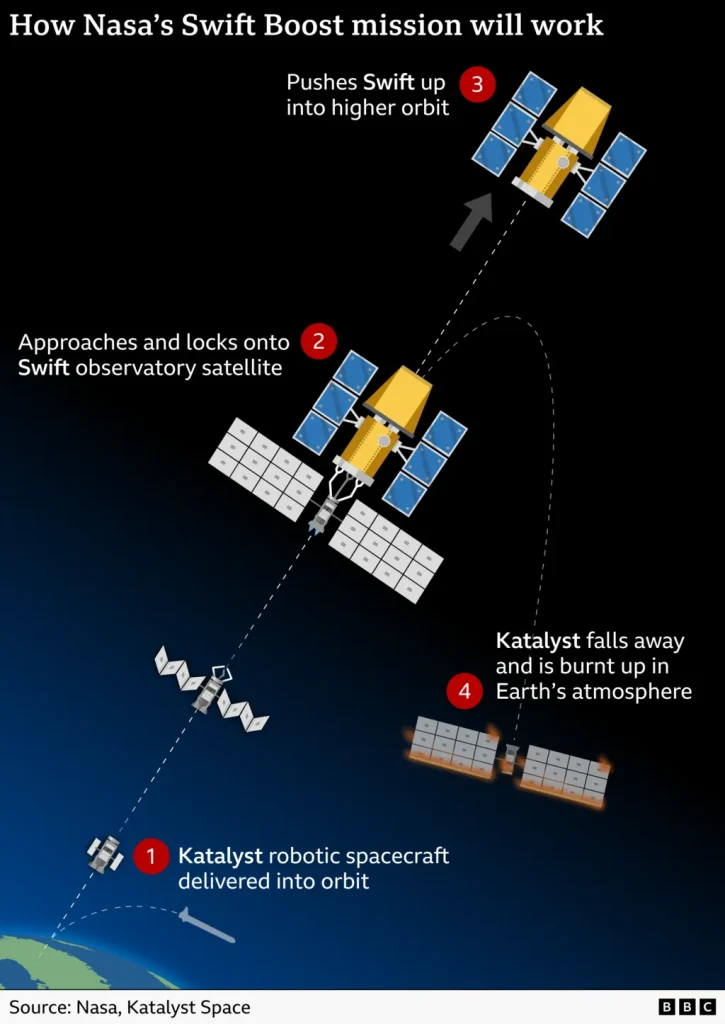
The rescue mission, launched on Friday, will see the LINK spacecraft attempt to intercept the Swift observatory, grab it using three robotic arms and boost it into a higher, safer orbit.
Scientists describe the mission as both groundbreaking and highly risky.
A First of Its Kind Rescue Mission
Space scientist Dr. Simeon Barber, a senior research fellow at the Open University, said the operation carries significant risks but could preserve an irreplaceable scientific instrument.
“But NASA obviously thinks it’s worth a go. And the science community is hopeful about this because it’s an important telescope that enables us to study super high energy phenomena that we have no other means to study.”
The LINK spacecraft is expected to approach Swift, securely dock with it, fire its engines to raise the telescope’s orbit, and then detach before eventually re entering Earth’s atmosphere and burning up.
Why Swift Is Falling Toward Earth
Swift’s gradual descent has been caused by increased solar activity, which has expanded Earth’s upper atmosphere.
Although the observatory orbits hundreds of kilometers above the planet, the expanded atmosphere creates drag that steadily slows the spacecraft and lowers its altitude.
When Swift was launched in 2004, it orbited Earth at approximately 373 miles (600 kilometers). Today, it has fallen to about 220 miles (360 kilometers), with most of that decline occurring over the past two years.
According to mission planners, once Swift drops below 186 miles (300 kilometers), any rescue attempt would become impossible.
A Telescope Unlike Any Other
Satellites routinely burn up as they re enter Earth’s atmosphere after completing their missions, but scientists say Swift is too valuable to lose.
About the size of a large car, the observatory carries three telescopes designed to detect gamma ray bursts, the most powerful explosions known in the universe.
These extraordinary events occur during the deaths of massive stars or when the remnants of dead stars collide. In just a few seconds, they can release as much energy as the Sun will emit during its entire 10 billion year lifetime.
Because these bursts last only briefly, Swift was specifically designed to respond rapidly and automatically, allowing scientists to capture these rare cosmic events almost immediately.
Researchers say no other spacecraft currently provides the same capabilities.
Katalyst Space Technologies Leads the Rescue
The rescue mission is being carried out by Katalyst Space Technologies, a young aerospace company based in Flagstaff, Arizona.
Chief Executive Ghonhee Lee said the team had less than a year to prepare and launch the mission before Swift descended beyond the point where it could be saved.
If LINK successfully captures and boosts Swift into a higher orbit, it could extend the observatory’s scientific mission by several more years while demonstrating technology that could one day be used to repair or rescue other satellites.
A New Era for Satellite Servicing
The mission represents a major test for the future of in orbit satellite servicing.
Success could pave the way for future missions that repair, refuel or reposition aging spacecraft instead of allowing them to burn up in Earth’s atmosphere, potentially extending the operational lives of valuable satellites and reducing space debris.
Source: BBC






Leave a comment