


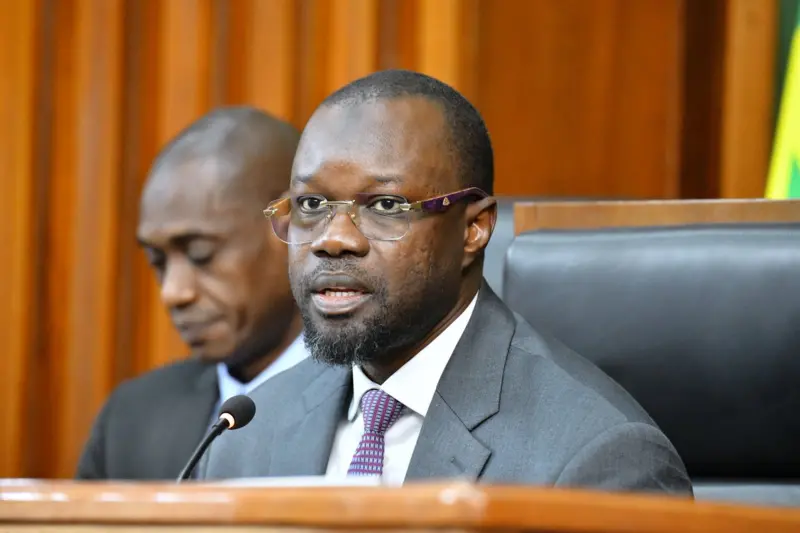
The constitutional reform proposal adopted by Senegal’s National Assembly on 29 June will ultimately be submitted to a national referendum.
Justice Minister Moussa Sarr announced before lawmakers that President Bassirou Diomaye Faye had decided to invoke Article 103 of the Constitution, allowing Senegalese citizens to vote directly on the proposed changes.
“The President wanted to inform the President of the National Assembly that he has decided to submit the adopted text to a referendum,” the Justice Minister said.
The reform, championed by the ruling PASTEF majority, represents one of the most ambitious institutional overhauls proposed in Senegal in recent decades. It seeks to strengthen Parliament, redefine the balance of power between the President and the Prime Minister, establish a Constitutional Court to replace the Constitutional Council, and reinforce the separation between state institutions and political parties.
Supporters view the reform as a decisive step toward modernising Senegal’s democratic institutions, while critics argue it could upset the country’s institutional balance.
The referendum will allow Senegalese voters to decide directly on reforms that formed a central promise of PASTEF’s 2024 presidential campaign.
Why is constitutional reform being proposed now?
Institutional reform was one of PASTEF’s flagship commitments during the 2024 presidential election, which brought President Bassirou Diomaye Faye to power. The party pledged to overhaul a political system it argued had concentrated excessive authority in the presidency.
Although President Faye remains officially a member of PASTEF, political relations between him and parts of the party leadership have become more complex since his election. This evolving political context has added significance to the constitutional debate.
Importantly, the proposal does not establish a new republic. Instead, it seeks to modernise existing institutions by redistributing powers and strengthening democratic oversight.
Supporters believe the reforms will correct longstanding institutional imbalances, while opponents fear they could significantly alter Senegal’s political system.
The main reforms
Creation of a Constitutional Court
One of the most significant changes is the replacement of the current Constitutional Council with a Constitutional Court.
The new court would consist of nine members, including seven judges, compared with the current seven-member Constitutional Council. Members would continue serving a single, non-renewable six-year term.
Its authority would be considerably expanded. The Constitutional Court would become the country’s highest judicial authority on constitutional, electoral and referendum matters while also overseeing the proper functioning of state institutions.
Its new responsibilities would include:
- reviewing administrative decisions related to national elections;
- examining constitutional challenges referred by higher courts;
- issuing decisions that would be legally binding on all public and private entities; and
- allowing the Prime Minister, in addition to the President and one-tenth of Members of Parliament, to refer cases directly to the court.
Supporters argue these changes would strengthen constitutional justice, while critics question whether sufficient safeguards exist to guarantee the court’s independence.
Rebalancing executive power
The reform also revises the relationship between the President and the Prime Minister.
Under the current Constitution, the President “determines the policy of the Nation.” The proposed amendment states that the President would determine national policy in consultation with the Prime Minister.
While the President would remain head of state and retain overall political leadership, government administration would increasingly fall under the Prime Minister’s responsibility.
The reform would also allow the Prime Minister to chair meetings of the Council of Ministers, but only with the President’s express authorisation and on an agenda determined by the head of state.
The Constitution would also formally recognise the position of deputy ministers.
Rather than introducing a parliamentary system, the proposal seeks to encourage greater cooperation within the executive while preserving the President’s central constitutional role.
Greater separation between the presidency and political parties
The proposed amendments would prohibit the President from leading a political party or coalition while in office.
The President could retain only an honorary role within a party and would be permitted to campaign only when seeking re-election.
The reform would also prohibit the head of state from holding any other public or private position, including unpaid roles.
According to its supporters, these measures would strengthen the neutrality of the presidency and reinforce the distinction between the state and political parties. Opponents, however, argue that they could weaken the relationship between the President and the governing majority.
Stronger parliamentary oversight
The National Assembly would receive expanded oversight powers.
Parliamentary committees of inquiry would be granted broader investigative authority, including the power to summon witnesses.
Lawmakers would also gain the right to adopt parliamentary resolutions expressing political positions.
The government would be required to provide Parliament with greater transparency regarding investment agreements involving natural resources and other strategic sectors.
The use of executive ordinances would also be more tightly regulated, requiring Parliament to define precisely the scope of any delegated legislative authority.
Additionally, ministers would no longer be allowed to simultaneously serve as mayors or presidents of departmental councils.
Regulating presidential transitions

The reform introduces new constitutional rules governing the period between a presidential election and the inauguration of a new president.
During this transition, the outgoing president would be restricted from making major long-term commitments on behalf of the state, including certain strategic contracts, international agreements and significant financial decisions, except where necessary to ensure continuity of government.
The objective is to prevent outgoing administrations from binding their successors through major last-minute decisions.
What would remain unchanged?
Despite these reforms, several key features of Senegal’s political system would remain intact.
The President would continue to be elected by direct universal suffrage and remain subject to the two consecutive five-year term limit.
The republican form of the state and the constitutional principles protected under Article 103 would also remain unchanged.
Rather than creating a new republic, the reform aims to modernise Senegal’s institutions, improve the balance between branches of government and strengthen democratic governance while preserving the country’s existing constitutional framework.
Source: Ousmane Badiane Digital Journalist BBC Africa








Leave a comment