


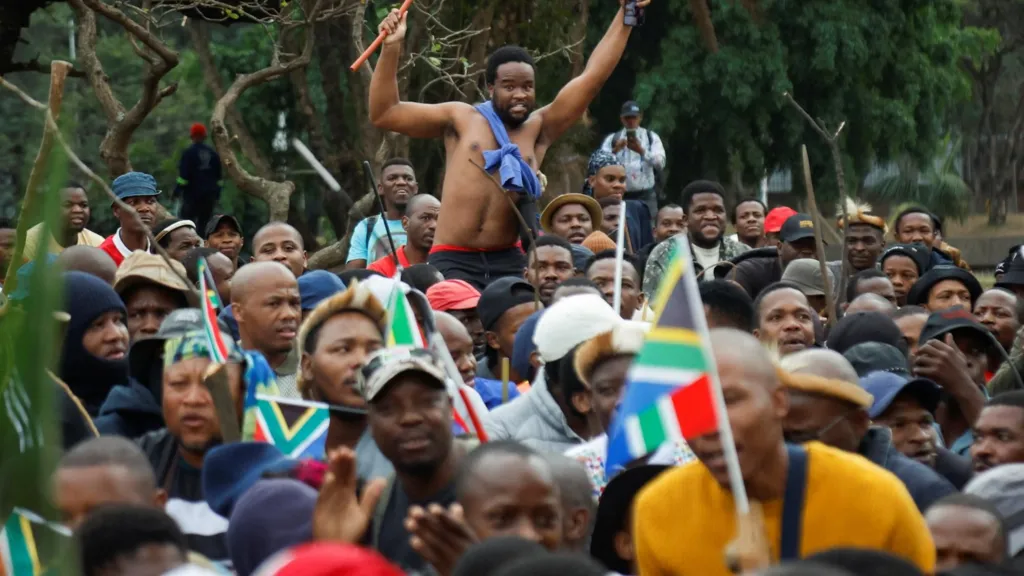
South African police have been deployed nationwide amid concerns that anti-immigration protests could turn violent, as President Cyril Ramaphosa urged demonstrators to reject “intimidation, threats or ultimatums.”
The protests coincide with an unofficial deadline set by campaigners demanding that all undocumented foreign nationals leave the country.
Fearing violence and intimidation, thousands of migrants have already departed. Police say approximately 25,000 undocumented migrants have been repatriated so far, most of them from other African countries.
One undocumented Malawian told the BBC he was “happy to be going back” but “heartbroken” to leave behind his four young children.
Peaceful Demonstrations Marred by Isolated Incidents
South Africa’s Ministry of Police said demonstrations have been largely peaceful, although isolated incidents of looting and vandalism have been reported.
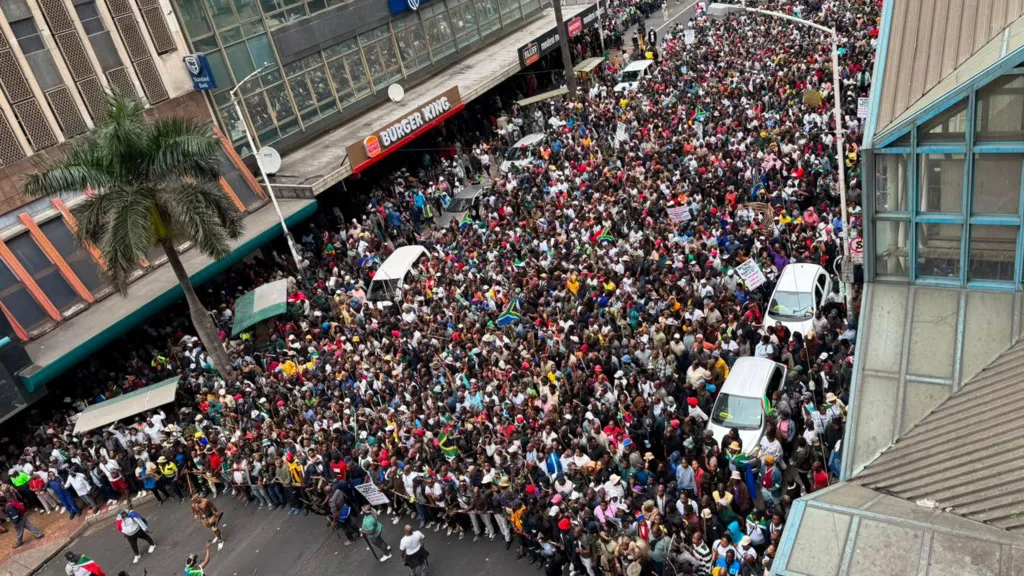
In Johannesburg, where one of the largest marches took place, businesses in the city centre remained closed while police maintained a heavy presence across major streets.
In the suburb of Yeoville, home to many African migrants, some protesters threw bricks, damaging windows in residential buildings.
Police arrested five people in Soweto for allegedly looting a foreign-owned shop. Another five suspects were detained in Hammarsdale, KwaZulu Natal, for allegedly breaking into a tuck shop.
Many businesses in central Durban also shut their doors as a police helicopter patrolled the city.
Ramaphosa Calls for Calm
Ahead of the demonstrations, President Ramaphosa met protest leaders in an effort to ease tensions.
While acknowledging public concerns over immigration policy, he emphasized that lawful foreign residents are protected by South Africa’s Constitution.
“Some foreign nationals who live in South Africa are here lawfully,” he wrote in his weekly newsletter.
“They work, study, raise families, invest in our economy and contribute positively to our society. They too are entitled to the protection of our laws and our Constitution.”
He added that while citizens have the right to protest and express their views, those rights do not extend to intimidation, vandalism or violence.
Immigration Remains a Divisive Issue
Official figures indicate that South Africa is home to more than three million documented foreign nationals. However, protesters argue that many more undocumented migrants remain in the country.
Police say around 50,000 undocumented migrants have been arrested since January.
A Soweto resident told the BBC that protesters simply wanted foreigners to comply with South African immigration laws and believed the strong police presence would help prevent violence.
Another protester from the anti-migrant movement Operation Dudula said demonstrators would continue pressuring authorities to remove undocumented migrants if police failed to do so.
Thousands Return Home
Nigeria evacuated 269 citizens on the eve of the protests, bringing the total number repatriated to around 600, with more evacuation flights expected.
Meanwhile, thousands of migrants have been waiting in temporary transit camps for weeks, fearing attacks if they returned to their communities.
In Durban, authorities have begun dismantling a transit camp housing mostly Malawian nationals.
According to Malawian media, around 7,000 Malawians have already returned home.
Women carrying their belongings waited in line to board buses back to Malawi as families prepared to leave.
Malawian migrant Nelson Mbewe said he had travelled to South Africa seeking employment to support his family.
“But we’ve faced challenges they’re saying we should go back home because we do not have the right documents,” he told the BBC.
“They call us Makwerekwere,” he added, referring to a xenophobic slur commonly directed at African migrants.
“It’s their country, so what can we do? We’ve accepted that we have to go back home.”
Another Malawian, Hassan Phiri, appealed for unity.
“All I want to say to South Africans is that we are all one. No matter what is happening, Africa must remain Africa.
“Africa can’t be Africa without South Africa, without Malawi, without anywhere. Whatever happens, we must love each other and stand together as Africans.”
Tight Security Measures
Authorities approved anti migrant marches in Durban, Johannesburg and several other cities while warning organizers they would be held responsible for preventing violence.
Police also announced that traditional weapons would not be permitted during demonstrations.
The restriction has raised concerns because many protesters are ethnic Zulus who traditionally carry shields, sticks and whips during marches. So far, police have largely allowed these items, confiscating only a machete during a protest in Durban.
Rising Deportations and Ongoing Xenophobia
The government says more than 12,000 undocumented migrants have been deported or repatriated since anti-migrant protests intensified earlier this year.
Countries including Ghana, Malawi, Mozambique, Nigeria and Zimbabwe have organized voluntary repatriation efforts by air and road, with approximately 3,500 people choosing to return home.
South African authorities claim that more than 500 Nigerians repatriated lacked valid immigration documents, a claim disputed by the Nigerian government.
Xenophobia has remained a persistent challenge in South Africa for years and has periodically erupted into violence.
According to the African Centre for Migration and Society’s Xenowatch tracker, two people have been killed in xenophobic incidents this year.
The country experienced one of its worst outbreaks of anti-foreigner violence in 2008, when riots claimed the lives of more than 60 people, underscoring the continuing challenge of balancing immigration enforcement with the protection of human rights.
Source: Nomsa Maseko ,BBC Africa, Durban, Khanyisile Ngcobo, Johannesburg, Farouk Chothia and Hafsa Khalil




Leave a comment